
Space & Satellite Technology
Cybersecurity for Space & Satellite Technology
The GOVSATCOM Hub and SpaceHub Cologne are creating new, security-critical infrastructure in the Cologne/Bonn region. NIS2 classifies the space sector as highly critical — we combine the new BSI TR-03184 guideline with years of ISMS experience under ISO 27001 and IT-Grundschutz.
A New Critical Sector with Growing Attention
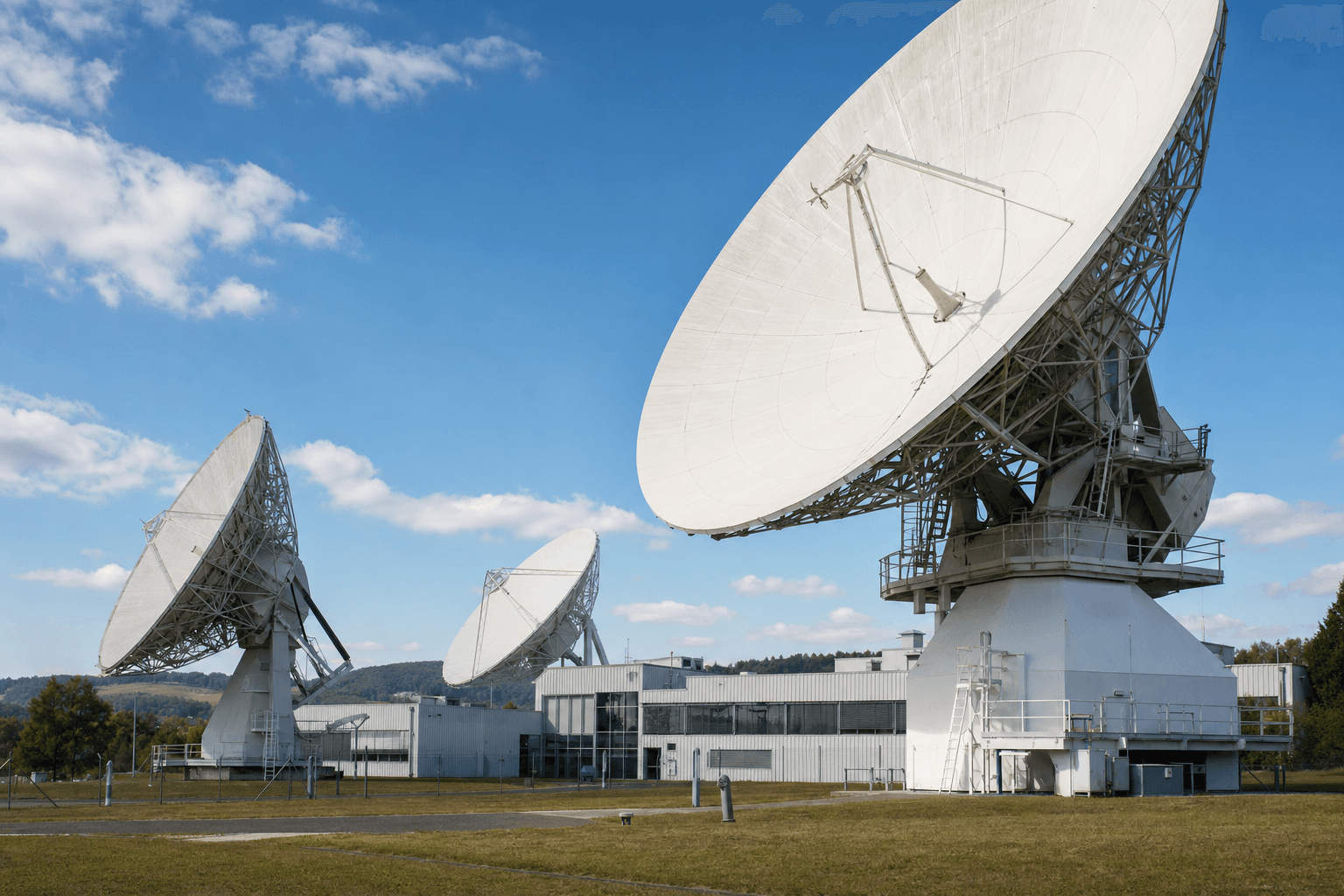
Satellite-based services have long become part of critical supply: navigation, Earth observation, and communication increasingly depend on space infrastructure, which in turn depends on ground stations, control centres, and antenna facilities on Earth. This dependency chain makes the sector strategically significant — and therefore a target for espionage and sabotage.
Concrete new infrastructure is emerging in the Cologne/Bonn region: with the GOVSATCOM Hub at the DLR site, the EU is building a highly secure network node for interception-resistant satellite communication for government agencies and disaster response. SpaceHub Cologne and the relocation of an ESA directorate to Cologne are additionally attracting companies and start-ups that are often engaging with European cybersecurity regulation for the first time.
Technically, the ground segment is following a development similar to that seen earlier in the energy sector: systems that used to operate in isolation are increasingly networked — for remote maintenance, monitoring, and data processing. This convergence creates attack surfaces that have long played no role in classical space architectures.
NIS2 Classifies the Space Sector as Highly Critical
The NIS2 Directive explicitly names the space sector as highly critical in Annex I — introduced via the supplementary CER Directive. This covers operators of ground infrastructure such as satellite control centres and ground stations, as well as providers of space-based services. Depending on company size, the classification applies as an essential or important entity, supplemented by the KRITIS-Dachgesetz with physical resilience obligations. One important exception: infrastructure operated by the EU under its own space programme does not automatically fall under this classification according to several assessments — this needs to be checked on a case-by-case basis.
BSI TR-03184: From IT-Grundschutz Profile to Assessment Grid for the Ground Segment
The technical guideline TR-03184 "Information Security for Space Systems" is not an isolated document but the latest link in a multi-year BSI series: in 2021 the BSI launched a working group with experts from BSI, OHB Digital Connect, Airbus Defence and Space, and the German Space Agency at DLR. This produced the IT-Grundschutz profile for space infrastructure on 30 June 2022, Part 1 of TR-03184 for the space segment (the satellite itself) on 31 May 2023, the IT-Grundschutz profile for space systems, Part 2: ground segment on 22 April 2024, and finally Part 2 of TR-03184 on 14 May 2025, which deepens that profile with an extensive threat/mitigation-measure table. For ground stations and control centres, this Part 2 is the relevant reference.
Methodologically, TR-03184 covers business processes across seven lifecycle phases — conception/design, manufacturing, testing, transport, commissioning, operations, and decommissioning. The focus is on systems with high or very high protection needs, though the recommendations can also be usefully applied to lower protection requirements. The guideline is compliant with ISO 27001/27002 — using the IT-Grundschutz methodology is not mandatory for this; other ISO-27001/27002-compliant approaches are equally permitted.
Measure BM18 "Define/Implement Configuration Management" shows how concrete this gets: it requires monitoring device configurations and configuration changes, for example via lifetime datasheets and version control. This addresses threats including exploitation of software vulnerabilities, information disclosure, sabotage via hardware or software, data falsification, device failure, and unauthorised parameter changes. The core message mirrors comparable international configuration-management standards: continuous monitoring rather than one-time hardening at commissioning.
Formally, TR-03184 is a recommendation, not a law. Practical weight comes from three channels: it is increasingly becoming part of tender specifications and contracts between clients and suppliers, the BSI offers its own certification scheme with an inspection specification to verify conformance at system and component level, and it sits within the regulatory context of NIS2 classifying the space sector as highly critical.
Why Our ISO 27001 and IT-Grundschutz Experience Matters Here
Methodologically, TR-03184 is not a new discipline but the application of established IT-Grundschutz logic to a new asset class: structural analysis, mapping threats to measures, and module-based thinking are exactly what IT-Grundschutz has delivered for years. Anyone with a working ISO 27001 or IT-Grundschutz practice transfers existing methodology to the ground segment instead of building an entirely new discipline.
We bring this methodology from direct experience: Our consultants have worked for years as external information security officers and CISOs for regulated organizations — covering mandates in DORA, NIS2, TKG, ISO 27001, and BSI IT-Grundschutz across sectors including energy, finance, insurance, and critical infrastructure. This hands-on experience is the foundation on which we translate BSI TR-03184 requirements into concrete ISMS structures.
This is complemented by our PKI specialisation: key and certificate management for uplink and downlink encryption is a central technical building block of the TR-03184 requirements. With Blackfort Certificate Intelligence, we have our own tool for inventorying and managing these certificate and PKI dependencies — instead of a manufacturer black box.
Our Work in Practice
Our engagements begin with an applicability assessment: does your own facility, service, or supplier role fall under NIS2 Annex I? This is followed by a structural analysis per IT-Grundschutz methodology — a complete asset inventory of the ground segment covering gateways, antennas, certificates, key material, and firmware versions.
This inventory forms the basis for mapping against the TR-03184 threat/mitigation-measure table — including concrete measures such as the configuration management defined in BM18. Gaps are prioritised by how critical the affected mission or service actually is, not by checklist logic.
From gap analysis to audit-ready documentation, we support the build-out of continuous configuration monitoring, preparation for BSI certification per the inspection specification, and the alignment of incident processes with NIS2 reporting deadlines — practical and technically grounded rather than a pure documentation exercise.
Our Services
- NIS2 applicability assessment and gap analysis for ground segment operators
- Structural analysis and asset inventory per IT-Grundschutz methodology for the ground segment
- Mapping against the BSI TR-03184 threat/mitigation-measure table
- ISMS implementation per ISO 27001 and BSI IT-Grundschutz for ground stations and control centres
- PKI and certificate management for satellite uplink/downlink
- Preparation for BSI certification/inspection specification for TR-03184 conformance
- Incident response and reporting processes per NIS2 deadlines
Applicable Regulations
- NIS2
- BSI TR-03184
- IT-Grundschutz Profile Ground Segment
- ISO/IEC 27001
- BSI KRITIS-Dachgesetz
- CER Directive
Industry-Specific Consulting
Talk to our experts about your specific requirements and regulatory obligations.
Request ConsultingFrequently Asked Questions
Is BSI TR-03184 mandatory for our company?
Formally, no — TR-03184 is a BSI recommendation, not a law. Practical weight comes from three channels: it is increasingly part of tender specifications and contracts, the BSI offers its own certification scheme with an inspection specification, and it sits within the context of NIS2 classifying the space sector as highly critical.
What is the difference between BSI TR-03184 Part 1 and Part 2?
Part 1 (published 31 May 2023) addresses the space segment, i.e. the satellite or spacecraft itself. Part 2 (published 14 May 2025) is aimed at operators, manufacturers, and service providers of ground segments — ground stations and control centres. For ground segment operators, Part 2 alone is the relevant reference.
How does the IT-Grundschutz profile relate to the technical guideline?
The IT-Grundschutz profile for space systems, Part 2: ground segment (22 April 2024) provides the foundation via a structural analysis — the relevant business processes, applications, and IT systems of an exemplary ground segment across its full lifecycle. TR-03184 Part 2 (14 May 2025) deepens this profile with an extensive table that systematically maps threats to mitigation measures.
Does our company fall under the NIS2 space sector?
NIS2 Annex I covers operators of ground infrastructure such as satellite control centres and ground stations, as well as providers of space-based services. Whether this means an essential or important entity depends on company size. One key exception: EU-owned space programme infrastructure does not automatically fall under this according to several assessments — we assess this case by case.
Do we need ISO 27001 certification to implement TR-03184?
No, that is not a prerequisite. TR-03184 is compliant with ISO 27001/27002 but does not mandate the IT-Grundschutz methodology — other ISO-27001/27002-compliant approaches are equally permitted. Anyone already operating an ISMS under ISO 27001 or IT-Grundschutz can transfer that existing methodology directly to the ground segment.
What does a concrete TR-03184 measure look like in practice?
One example is measure BM18, "Define/Implement Configuration Management": it requires monitoring device configurations and changes, for example via lifetime datasheets and version control. This addresses threats including software vulnerabilities, information disclosure, sabotage, data falsification, device failure, and unauthorised parameter changes — with continuous monitoring rather than one-time hardening as the core principle.
Kontakt aufnehmen
Ready to address your industry-specific security requirements?
Sprechen Sie mit uns über Ihre Sicherheitsanforderungen – konkret, ohne Verpflichtung und auf Augenhöhe.