

A research team from the University of California San Diego and the University of Maryland used about 800 US dollars of consumer receiving gear — a consumer satellite dish with a motor and a TV tuner card — on the roof of a university building in San Diego to read the IP traffic of geostationary satellites. The result, presented at ACM CCS ’25 in Taipei and awarded a Distinguished Paper Award: 50% of the observed GEO links carried their traffic in the clear. According to the study, this included phone calls and text messages from cellular backhaul, industrial control systems of utilities, military asset tracking, inventory data of global retailers, and in-flight Wi-Fi.
What is troubling here is neither the equipment nor a clever attack. It is the absence of encryption. Anyone standing inside a transponder's footprint who points a dish at it receives the signal — that is all it takes.
Cleartext share: 50% of the observed GEO links unencrypted
Scan scope: 39 satellites, 411 transponders, 25 longitudes
Effort: ~800 US dollars of passive receiving gear
Source: University of California San Diego & University of Maryland
Publication: ACM CCS ’25 (Distinguished Paper Award)
DOI: 10.1145/3719027.3765198
We reproduced the core of this finding in an isolated lab, fully software-defined in GNU Radio and with purely synthetic, invented frames. There was no real radio reception and no third-party data. We rebuilt the chain ourselves: our own unencrypted downlink, a software receiver that demodulates it — and, next to it, the same chain with an encrypted payload. This article explains why such links lie open, what threat model that implies, and how the safeguard works; backed by the real material from the run.
The problem: a strong signal that everyone in the footprint receives
A geostationary satellite sits fixed above a point on the equator and beams its downlink signals back to Earth through transponders. A single transponder footprint covers a very large part of the Earth's surface — up to about a third, according to the study. Anyone inside that area who runs a properly aimed dish gets the same signal as the intended ground receiver. Reception is passive: nothing is transmitted, nothing is disturbed, nothing in the connection is touched. From the outside, such eavesdropping cannot be detected.
Confidentiality therefore rests entirely on the encryption of the transmitted data. And that is exactly where the gap is. In satellite TV, encryption at the transmission layer has been standard for decades. On the IP backhaul links that connect cellular networks, corporate sites, utilities and others, it was often missing according to the study — and missing on both levels, the link and the network layer. The IP traffic then ran raw across the satellite.
So there is no broken cryptography and no exploit in the usual sense. There is an assumption that does not hold: that a signal you cannot see, and whose reception requires expertise, is therefore also confidential. The term for this is “security by obscurity.” It holds exactly until someone with an 800-dollar dish takes a look.
Scenarios: who can listen in — and what is at stake
The threat model is unusually simple. The listener needs no access to a network, no stolen credentials, no position “in the middle” of the connection. They need a dish in the footprint and patience. They are purely passive and stay invisible, because they change nothing about the connection. What this model cannot defeat: an encrypted payload — because then they receive the same signal but can do nothing with it.
What the team observed in unencrypted traffic over three years cuts, according to the study, straight across critical sectors: cellular backhaul with cleartext call and text content from several providers, industrial control of utility infrastructure (job scheduling, ICS/SCADA), military asset tracking, inventory management of global retailers, and passengers' in-flight Wi-Fi.
Individual affected operators were named and encrypted their links after the researchers' disclosure. We deliberately do not name them here. What matters is the pattern: sensitive internal links running openly over a satellite whose signal a large part of a continent can receive.
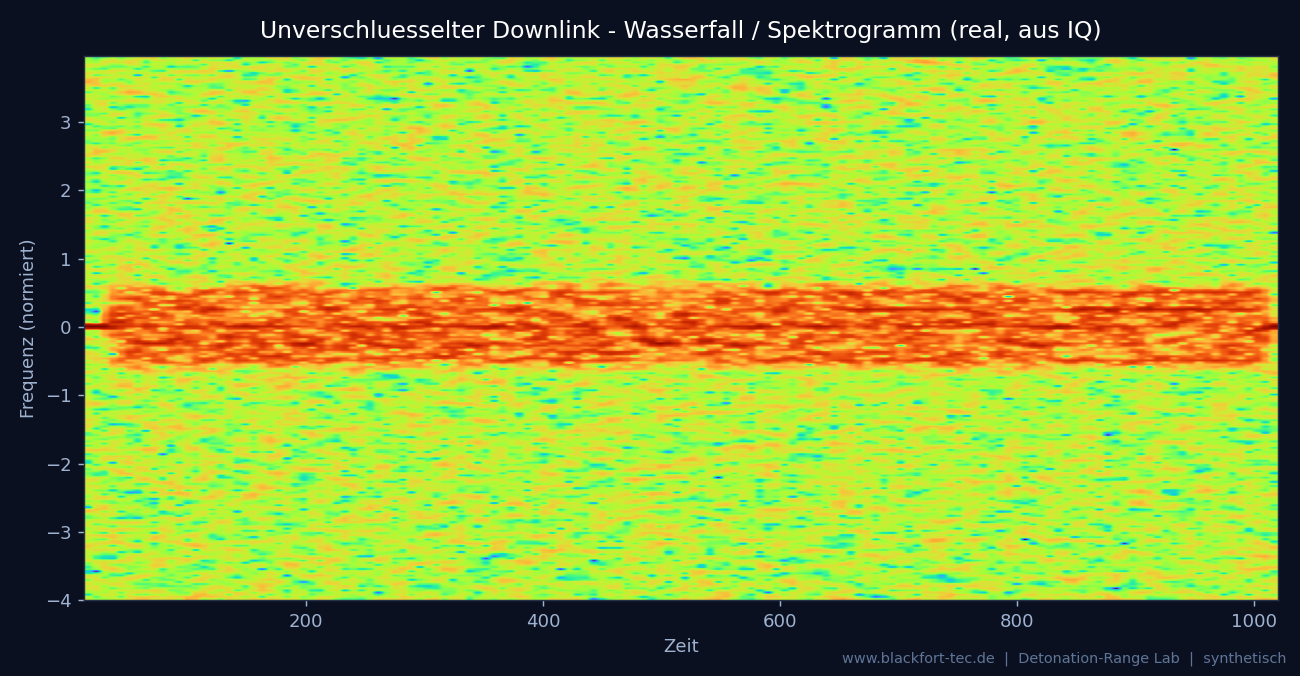
This is what the receiving side looks like in the lab. The software receiver picks up the unencrypted downlink; in the waterfall spectrogram the carrier band of the signal is clearly visible:
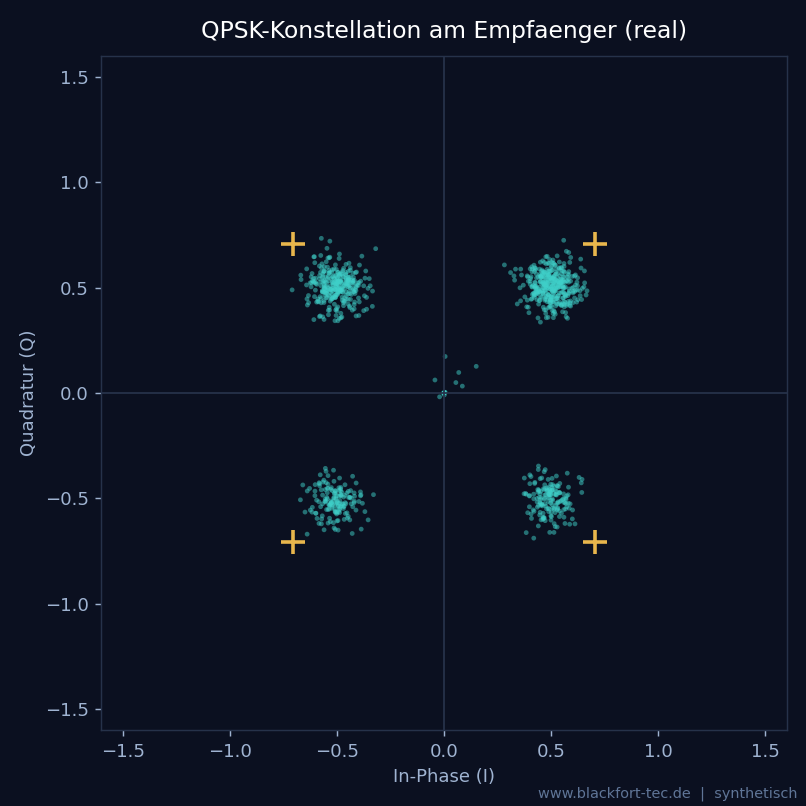
After demodulation the symbols settle into four clean clusters — an intact QPSK constellation, so the signal is fully recovered:
And because the payload is unencrypted, the decoded frames then sit there in the clear — in the lab deliberately with invented content marked as synthetic. The cleartext is the leak:
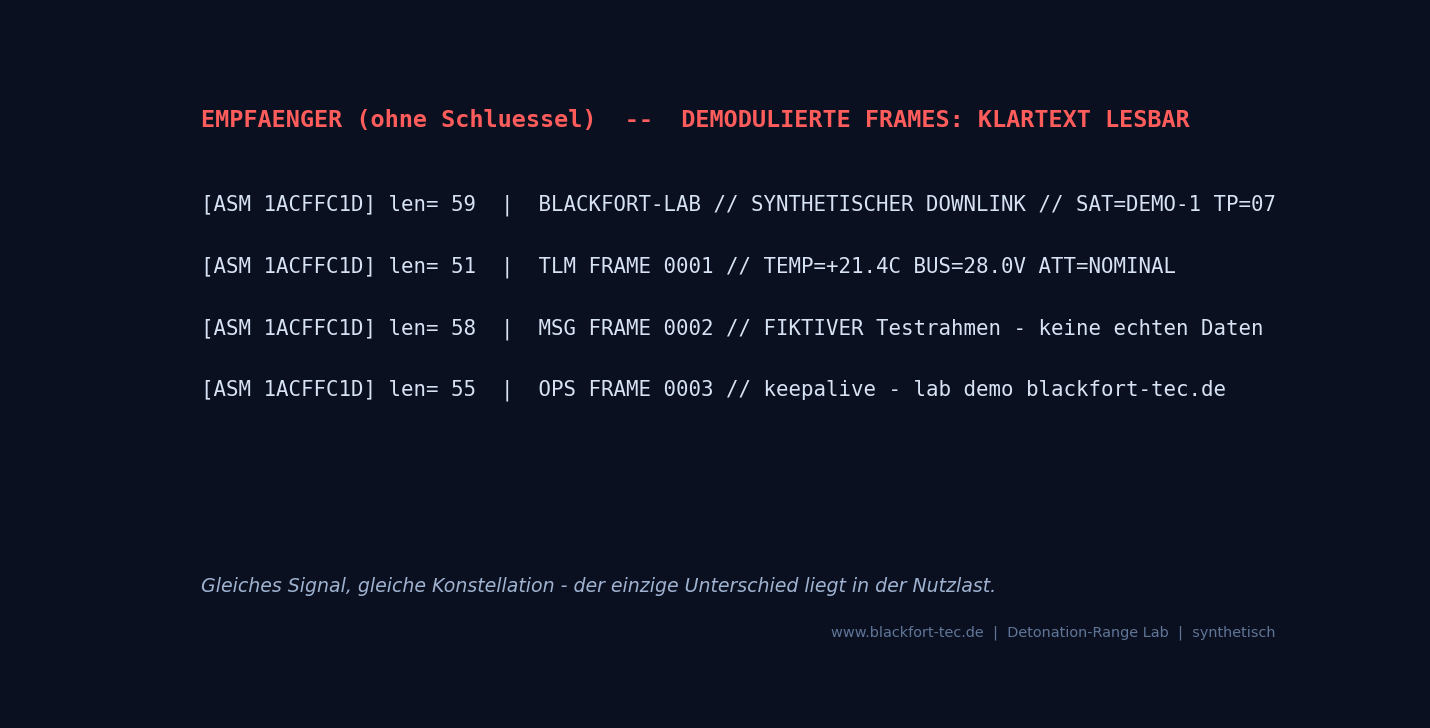
That final step would happen on a real, open downlink as well — only there it would be actual calls, telemetry or business data.
Solution: encryption at every layer, mandatory
The remedy is not a new technology, it is a decision: data in transit is encrypted, regardless of the medium. For radio and satellite links that means encryption at the transmission and the network layer, so the payload stays protected even if a single layer fails. This is defense-in-depth in practice: several independent layers, so that one fault does not lay everything bare.
Why that is enough is shown by the same lab setup with a single change — the payload is encrypted before transmission (AES-256), the framing stays the same. Afterwards the radio path is indistinguishable: waterfall and constellation look just as before. The receiver demodulates just as cleanly:
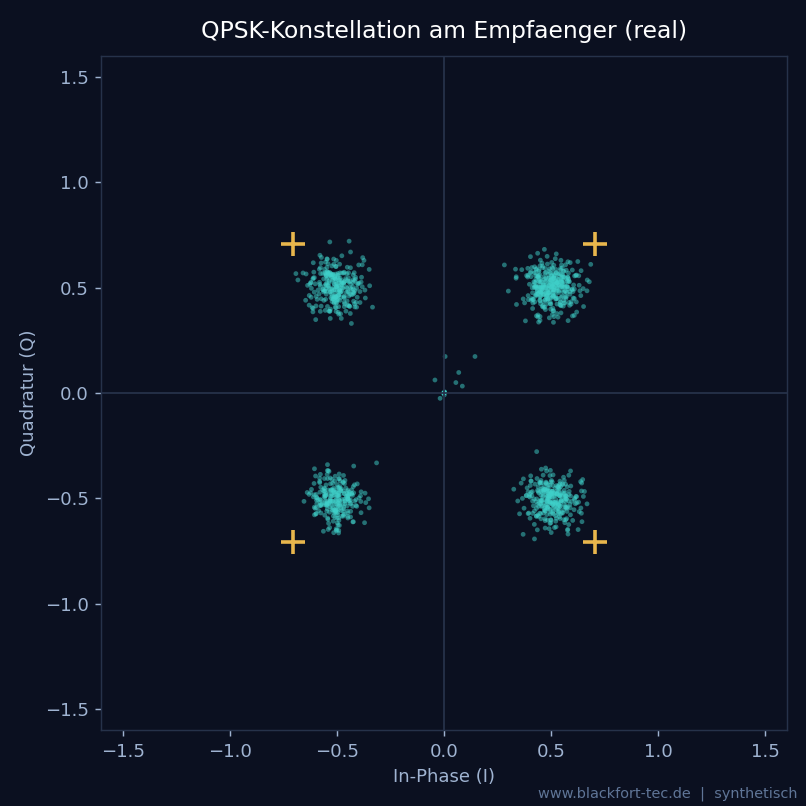
The only difference is in the last step. The same receiver that just produced cleartext now sees only ciphertext — bytes that are unreadable without the key:
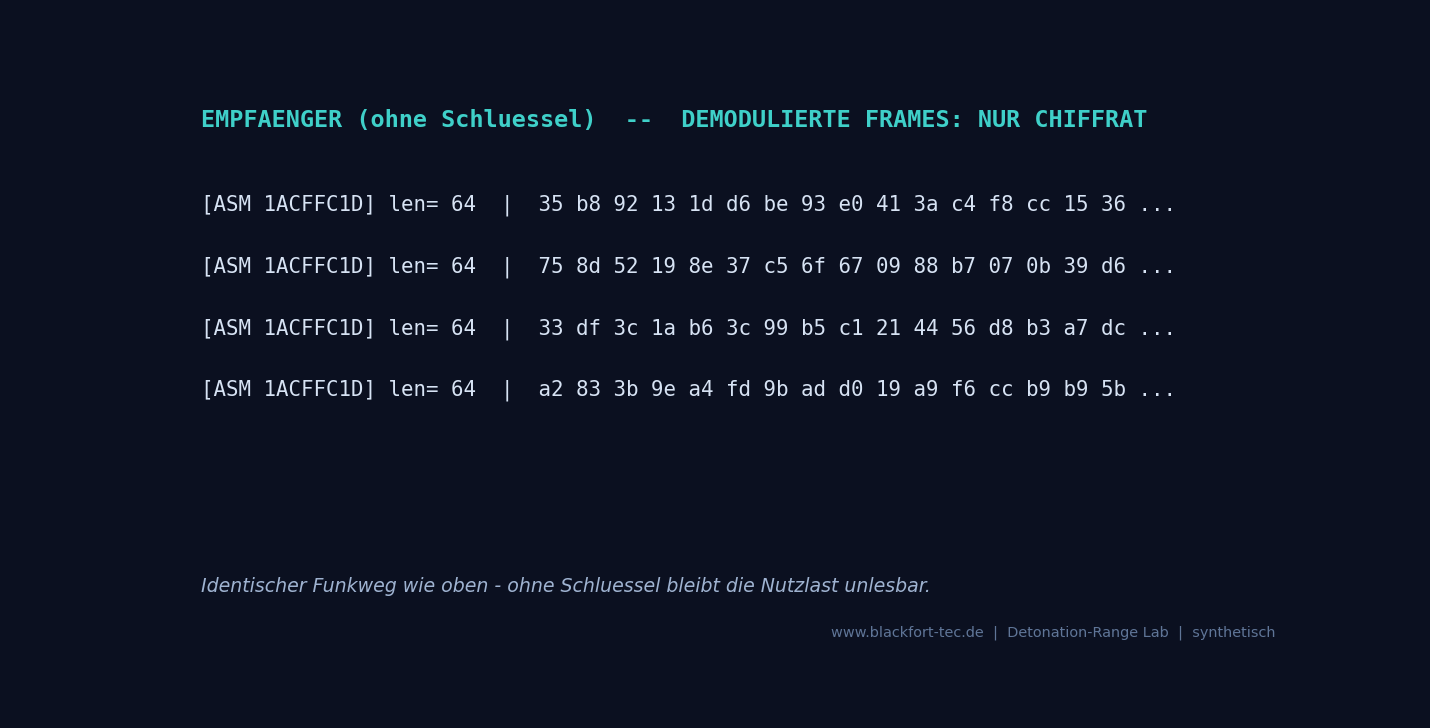
That is the whole point. The signal is just as receivable as before. The listener still gets it — they just can no longer read it. Encryption is the only layer that holds at all in the footprint model.
For organisations with a lived security management this is more than a recommendation. An effective ISMS (for example under ISO/IEC 27001) calls for a documented cryptography policy and the protection of transmission paths — the case shows how a blind spot, trusting in the “invisibility” of the medium, undermines a central control. Anyone connecting sensitive sites over radio or satellite links should anchor the encryption of those paths explicitly in policy and architecture.
What it means for operations
This case is a lesson against “security by obscurity”: a medium that seems hard to observe is no substitute for a control. Anyone carrying sensitive internal links over radio or satellite must establish confidentiality actively through encryption of the transmission paths — at the transmission and the network layer. That belongs in a documented cryptography policy and in the architecture, not in a silent assumption.