


As of the date of this article (17 November 2026) it is about six weeks until the BAIT, BaFin's supervisory requirements for IT in banks, come to an end. BaFin repeals Circular 10/2017 (BA) in full at the end of 31 December 2026. For CRR credit institutions this changes nothing, because they have worked under the Digital Operational Resilience Act (DORA, Regulation (EU) 2022/2554) since January 2025. For a smaller group the turn of the year is the real deadline: according to BaFin mainly factoring and finance leasing firms, guarantee banks, housing companies with savings schemes, third-country branches and other institutions that are brought under DORA only by the German Banking Act (KWG). From 1 January 2027 they apply DORA under the simplified ICT risk management framework of Article 16.
This article explains who is affected, what applies from the deadline, which questions are still open and which steps make sense until then. It reflects the position as of 17 November 2026. It is meant as orientation and is not legal advice for any individual case.
What BaFin is repealing and why
DORA has applied since 17 January 2025. In BaFin's view it essentially covers the content of BaFin's IT circulars. To avoid double regulation, BaFin withdrew the circulars in two steps:
- Step one, January 2025. The KAIT (asset management companies), the VAIT (insurers) and the ZAIT (payment and e-money institutions) were repealed at the end of 16 January 2025. Since 17 January 2025 the BAIT no longer cover institutions that must run ICT risk management under Articles 5 to 15 or Article 16 DORA, which mainly means CRR credit institutions. Chapter 11 of the BAIT was deleted. The version in force is the circular as amended on 16 December 2024.
- Step two, turn of the year 2026/2027. For the remaining institutions the BAIT stay in place until the end of the transition period, so that no regulatory gap arises. They cease to apply in full at the end of 31 December 2026.
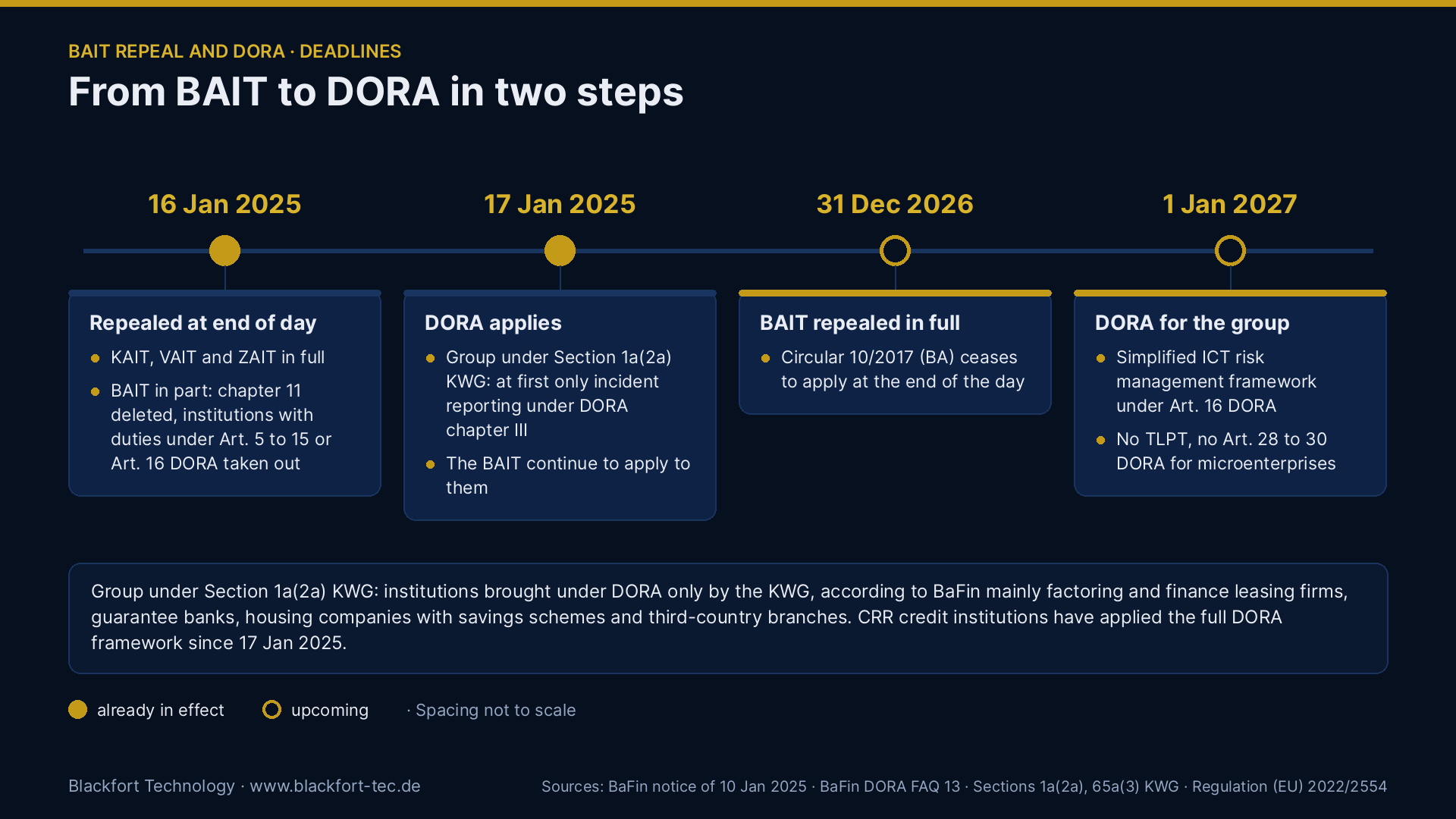
The legal basis for step two was added to the KWG by the Financial Market Digitalisation Act (FinmadiG). Under Section 1a(2a) KWG, DORA and the acts adopted on its basis (Level 2) apply to all institutions not already covered by Article 2 DORA as if they were CRR credit institutions. Section 65a(3) KWG makes this rule applicable from 1 January 2027. BaFin's notice of 10 January 2025 refers to Section 1a(2) KWG ("§ 1a Absatz 2" in the German original) at this point. In the statute, however, Section 1a(2) concerns the entities named in the Capital Requirements Directive (according to BaFin, the regional promotional banks). The rule for the remaining institutions is in Section 1a(2a), applicable under Section 65a(3) KWG, and BaFin's FAQ cites it that way. In our reading the notice refers to this rule.
The individual BAIT chapters and the complete mapping to DORA are shown on the page From BAIT to DORA: what falls away, what stays, what is new.
Who is affected and what applies from 1 January 2027
Institutions under Section 1a(2a) KWG
In its DORA FAQ (as of January 2025) BaFin names mainly these institutions:
- guarantee banks,
- financial services institutions, in particular finance leasing and factoring firms and crypto securities registrars,
- housing companies with savings schemes,
- third-country branches and branches under Section 53 KWG.
The list is not exhaustive. An institution that also conducts deposit-taking and lending business is a CRR credit institution and has been directly subject to DORA since 17 January 2025, under the full framework of Articles 5 to 15.
What changes on the deadline
DORA applies to this group in two stages. Incident reporting under Chapter III, that is the handling, classification and reporting of ICT-related incidents, has applied since 17 January 2025. Everything else applies from 1 January 2027, with three deviations set out in Section 1a(2a) sentence 2 KWG:
- Simplified framework. Instead of Articles 5 to 15, the simplified ICT risk management framework under Article 16 DORA applies. It is specified in Title III (Articles 28 to 41) of Delegated Regulation (EU) 2024/1774.
- No TLPT. Threat-led penetration testing under Articles 26 and 27 DORA does not apply.
- Microenterprises without third-party risk rules under Articles 28 to 30 DORA. These articles of Regulation (EU) 2022/2554 on ICT third-party risk do not apply to microenterprises in the group. Articles 28 to 30 of Delegated Regulation (EU) 2024/1774 are not affected. Under Article 3(60) DORA a microenterprise employs fewer than ten persons and has an annual turnover and/or annual balance sheet total that does not exceed EUR 2 million. Whether turnover or balance sheet total is decisive is not entirely clear from the wording ("and/or", German "bzw."). With a large receivables or leasing portfolio, the balance sheet total will in our assessment usually be higher, but with low turnover and fewer than ten employees the status may still come into consideration. Each institution should check it against its own figures rather than assume it.
What the Article 16 obligations require in detail, with an evidence matrix for each article, is set out on the page on the simplified ICT risk management framework under DORA Article 16.
What falls away and what is expressly required
In a supervisory notice of 21 August 2025, BaFin compared the BAIT with the simplified framework. Its overall view: the requirements are lower than those of the BAIT, and for third-party risk the differences are smaller. By its own statement the notice is not a binding interpretation. Some examples:
- The information security officer under Chapter 4 BAIT has no counterpart in the simplified framework. An ICT risk control function is not required either. The RTS still requires an information security policy and security measures (Article 29). The simplified framework does not expressly say who performs these tasks. The institution should decide this and document the decision.
- The simplified framework no longer requires a backup concept or an IT emergency concept. Backups themselves and business continuity plans with backup and recovery remain mandatory. Sector-specific business continuity requirements continue to apply alongside. For financial services institutions, MaRisk (BaFin's Minimum Requirements for Risk Management) applies to the extent warranted by size and business, including emergency management under AT 7.3. How far this applies to the other institutions in the group must be assessed case by case.
- The framework expressly provides for a business impact analysis approved by the management body (RTS Article 28(2)(d)). Business continuity plans set out planned recovery levels and time frames (RTS Article 39(2)(d)) and are tested at least once a year for backup and recovery (RTS Article 40).
- Automated vulnerability scanning and the application of patches must be ensured explicitly.
- For third-party risk, Articles 28 to 30 DORA apply in principle in the simplified framework too, except to microenterprises in the group. A separate strategy on ICT third-party risk under Article 28(2) is not required in the simplified framework.
What these points mean in practice for factoring and finance leasing firms is answered on the page Factoring and leasing under DORA.
What the sources leave open
The sources we have read do not answer three questions:
- Financial holding companies. According to BaFin's FAQ the BAIT also apply to financial holding companies. The FAQ's wording on the period from 1 January 2027 allows more than one reading. We found no clear statement in the sources on what applies to them once the BAIT are repealed, and Section 1a(2a) KWG does not expressly name them. Independently of this, supervised entities outside DORA must also handle ICT and cyber risks appropriately as part of a proper business organisation.
- First register of information. Article 28, and with it the register of information, applies to the group from 1 January 2027 (not to microenterprises). None of the sources states whether the first submission is due in 2027 with reference date 31 December 2026 or only in 2028. Pointers for preparation are on the page on the DORA register of information.
- Weekend rule for reports. Under Article 5(5) of Delegated Regulation (EU) 2025/301, credit institutions are excluded from the deadline extension for initial and intermediate reports at weekends. Because the group applies the Level 2 acts as if it were a CRR credit institution, it is open whether the relief applies to it. We recommend planning without it.
Which steps make sense before the deadline
Until 31 December 2026 the BAIT continue to apply to these institutions, including the information security officer and IT emergency management. The rebuild therefore runs alongside day-to-day operations. From the sources we derive an order of steps we consider sensible:
- Clarify classification. Does the institution belong to the group under Section 1a(2a) KWG, or is it a CRR credit institution? Is it a microenterprise under Article 3(60) DORA? Document all criteria (headcount, turnover or balance sheet total) with figures and have borderline cases clarified legally.
- Check incident reporting. Reporting has applied since 17 January 2025. Classification, reporting channels and deadlines should be practised before the rest of the framework arrives.
- Review the BAIT documentation. Map every existing document to the new framework: keep as is, rebuild or merge. An institution can keep roles such as the information security officer, but the simplified framework no longer contains an explicit requirement for them.
- Close the gaps. Information security policy under RTS Article 29, classification of critical or important functions (RTS Article 30), business impact analysis for approval by the management body, recovery objectives per function, test plan and logging.
- Capture service providers. Identify key dependencies on ICT third-party service providers. In our reading this also applies to microenterprises, because Article 16 DORA and RTS Title III require this identification independently of Articles 28 to 30 DORA. For all others, the register of information and contractual provisions under Article 30 DORA come on top.
- Involve the management body. Overall responsibility, budget and the approvals under RTS Article 28(2) lie with the management body. Resolutions should be prepared before the turn of the year.
To move BAIT documentation into the simplified framework, Blackfort Technology offers the package transition from BAIT into the simplified framework under DORA Article 16: inventory, rebuild of policies and procedures as drafts for the institution to adopt, roles, classification of critical or important functions, a supported recovery and reporting drill, and evidence handover.
Sources
- BaFin notice of 10 January 2025 (German): https://www.bafin.de/SharedDocs/Veroeffentlichungen/DE/Meldung/2025/meldung_2025_01_09_DORA.html
- BaFin letter to the associations of 19 December 2024 (German): https://www.bafin.de/SharedDocs/Downloads/DE/Anlage/Informationsschreiben_an_die_Verbaende_BAIT.pdf?__blob=publicationFile&v=1
- BaFin DORA FAQ, questions 02 and 13 (German): https://www.bafin.de/SharedDocs/FAQs/DE/DORA/DORA_Landingpage/02.html and https://www.bafin.de/SharedDocs/FAQs/DE/DORA/DORA_Landingpage/13.html
- Sections 1a and 65a KWG (German): https://www.gesetze-im-internet.de/kredwg/__1a.html and https://www.gesetze-im-internet.de/kredwg/__65a.html
- Regulation (EU) 2022/2554: https://eur-lex.europa.eu/legal-content/EN/TXT/?uri=CELEX:32022R2554
- Delegated Regulation (EU) 2024/1774: https://eur-lex.europa.eu/legal-content/EN/TXT/?uri=CELEX:32024R1774
- Delegated Regulation (EU) 2025/301: https://eur-lex.europa.eu/legal-content/EN/TXT/?uri=CELEX:32025R0301
- MaRisk, Circular 06/2026 (BA) (German): https://www.bafin.de/SharedDocs/Downloads/DE/Rundschreiben/dl_rs_0626_9_marisk.pdf?__blob=publicationFile&v=3
- BaFin supervisory notice of 21 August 2025 on Article 16 DORA (German): https://www.bafin.de/SharedDocs/Downloads/DE/Anlage/Aufsichtsmitteilung/dl_2025_08_21_Aufsichtsmitteilung_Hinweise_Artikel_16_DORA.pdf?__blob=publicationFile
As of 17 November 2026. This article provides a professional assessment and is not legal advice. Whether and how the rules apply to a specific institution must be assessed case by case.